
S.A.P.E.L.O. is Four Years Old!
By: Patricia A. Hembree, S.A.P.E.L.O. Program Coordinator
Department of Science Education, UGA
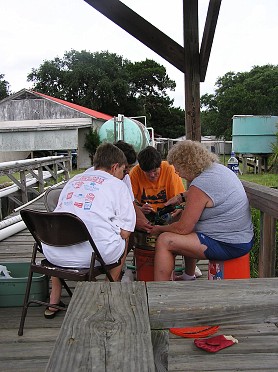
| S.A.P.E.L.O. - Scientists and Professional Educators Learning Outdoors - is the Schoolyard Program for the Georgia Coastal Ecosystems Long Term Ecological Research (GCE-LTER) Project. In the year 2000, a team of six teachers with the Georgia Association of Marine Education spent four days on Sapelo, testing a potential design for the program. The first full workshop, funded with the National LTER Schoolyard supplemental grant, was conducted in the summer of 2001, hosting 10 teachers representing all areas of the state. Since then, the program has grown, operating two sessions each summer. To date, the program has provided a total of 55 teacher positions - and those teachers have now served over 5300 K12 students in Georgia. Funding for the program thus far includes $60,000 from the National Science Foundation's LTER Schoolyard supplemental grant and over $125,000 from Georgia's Teacher Quality Higher Education Program - a federally funded program through the United States Department of Education as a part of the No Child Left Behind Act. |  (photo courtesy of Patricia Hembree) |
 (photo courtesy of Patricia Hembree) |
This growing team of formal and informal educators is learning about Georgia-based science and mathematics by actually DOING scientific research. The participants work in collaborative, residential, field-based teams with other teachers, graduate students, and the GCE LTER scientists as a community of learners. The purpose of these collaborations is to develop or enhance teacher appreciation for and understanding of the science and mathematics behind the GCE LTER and the way this type of science differs from the traditional school based science. In turn, the graduate students and scientists gain valuable insight into science teaching and the K12 classroom of today. Intending to mimic the goals of the LTER Network, support for the teacher/participants in S.A.P.E.L.O. is over long temporal and broad spatial scales-teachers may participate for as many seasons as they can and teachers from all teaching situations and areas of Georgia may apply. Needless to say, this long term aspect of teacher participation provides unique mentorships on multiple levels. More importantly, it provides those teachers with a sense of continuity within the research process and a depth of understanding about those processes that can never be replicated in textbooks. And that is the view of science-Georgia science-that will be passed on to the students of those teachers. |
| This Schoolyard program is meant to complement, not compete, with the existing education programs on the Georgia coast. These existing programs include summer courses for educators that are taught at the Marine Education Center and Aquarium at Skidaway, day tours for school groups by the Sapelo Island National Estuarine Research Reserve, and the many wonderful programs for student and teacher groups conducted by a variety of private and public facilities along the coast. The Schoolyard program differs from these existing programs as it focuses to establish a long termed partnership between the GCE LTER and the schools through the teachers. Additionally, teachers are supported throughout the academic year including: letters, emails, and telephone contact between participants and GCE LTER personnel; classroom visits by the Schoolyard coordinator; a return trip to Sapelo in the late fall and early spring; and honoraria to purchase classroom materials to establish parallel research projects. The teachers involved with the GCE SLTER are also given a collection of reference books and receive financial support to attend a professional conference and present the stories and research results of their participation in and experiences with this Schoolyard program. | 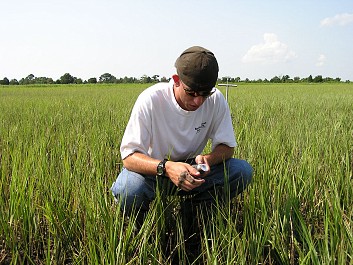 (photo courtesy of Patricia Hembree) |
| If you have any questions, comments or stories to contribute, please feel free to contact me via email: phembree@uga.edu. | |

