
GCE Educational Activities
January, 2004 - S.A.P.E.L.O. is Four Years Old!

(photo by Patricia Hembree)
by Patricia A. Hembree
Dept. of Science Education, UGA
S.A.P.E.L.O.-Scientists and Professional Educators Learning Outdoors-is the Schoolyard Program for the Georgia Coastal Ecosystems Long Term Ecological Research (GCE-LTER) Project. In the year 2000, a team of six teachers with the Georgia Association of Marine Education spent four days on Sapelo, testing a potential design for the program. The first full workshop, funded with the National LTER Schoolyard supplemental grant, was conducted in the summer of 2001, hosting 10 teachers representing all areas of the state.
Since then the program has grown, operating two sessions each summer. To date, the program has provided a total of 55 teacher positions - and those teachers have now served over 5300 K12 students in Georgia. Funding for the program thus far includes $60,000 from the National Science Foundation's LTER Schoolyard supplemental grant and over $125,000 from Georgia's Teacher Quality Higher Education Program-a federally funded program through the United States Department of Education as a part of the No Child Left Behind Act.... (read full article)
January, 2004 - GCE-LTER Schoolyard Coordinator wins Two Awards
Patricia Hembree, a doctoral student and GCE-LTER Schoolyard coordinator, was awarded the Excellence in Teaching Award from the Graduate School at they graduate teaching assistant who "demonstrates superior teaching in the classroom or laboratory." This award is given annually to five graduate students who are nominated by the faculty and students of their department. It carries a monetary award of $1,000. Patricia used those funds to take her class of pre-service science teachers to Sapelo for "some serious reflection about real science in action!" (for more information, see the UGA College of Education Spotlight article).
This honor followed closely behind her winning the Outstanding Teaching Assistant Award that recognizes outstanding graduate teaching assistants. Recipients of the Outstanding Teaching Assistant Award are recognized at Honors Day and receive a certificate and letter of appreciation from the Vice President for Academic Affairs.
March, 2003 - UGA Marine Biology Class Collects Fouling Community Data
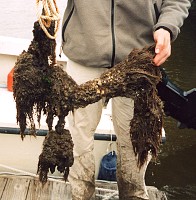
Fouling community sampler heavily colonized by invertebrates after 1 year in the field (photo courtesy of Dr. Merryl Alber)
On March 8, 2003, Merryl Alber and Dale Bishop led students in the UGA Marine Biology 3450 class on a field trip to Sapelo Island to retrieve the fouling community samplers installed by students in the previous year's class (see March 2002 highlight article below).
The class focuses on barnacles (Balanus eburneus) and tunicates (Molgula manhattensis), which are two of the main colonizers, but also makes a list of all of the species observed. Preliminary fouling data and a description of this project are available on the Fouling Community Study web page, and when all species identifications are complete the list of organisms will be added to the GCE Taxonomic Database.
For further information about this project, please contact:
Dr. Dale Bishop
Department of Marine Sciences
University of Georgia
Athens, GA 30602-3636
email: tdbish@uga.edu
Summer, 2002 - Double Your Pleasure, Double Your Fun.er.Funding! Teachers and LTER Scientists Reap the Rewards of Additional Funding

(photo by Ken Leach)
Patricia A. Hembree, S.A.P.E.L.O. Program Coordinator
Department of Science Education, UGA
The GCE-LTER Schoolyard Project, S.A.P.E.L.O. - Scientists and Professional Educators Learning Outdoors - was able to double its summer program for teachers this year. Thanks to a grant of nearly $25,000 from the Georgia Eisenhower Higher Education Program that was added to the NSF LTER education grant, Sapelo served as an outdoor classroom for 17 teachers during two separate weeks this summer. Following a format similar to last year's successful model, the teachers joined research teams in the daily research activities that make Sapelo so beguiling.... (read full article)
March, 2002 - University of Georgia Marine Biology Class Establishes a Long-Term Invertebrate Data Base.
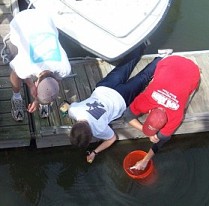
Students collecting organisms from fouling communities on the floating dock at Marsh Landing (photo courtesy of Dr. Mary Ann Moran)
Drs. Mary Ann Moran, Merryl Alber, and Dale Bishop are leading students in establishing a web-based long-term monitoring program of attached invertebrate communities on Sapelo Island. On March 9 and 10, 2002, UGA undergraduates enrolled in MARS3450 inventoried attached ("fouling") invertebrate communities from natural and man-made structures in the subtidal region of salt marsh drainage creeks at GCE-LTER sites (sites GCE10 and ML). The students installed invertebrate samplers at three docks along a salinity gradient in the Duplin River. Next year's MARS3450 students will retrieve the samplers, record invertebrate abundances by location and depth, and archive data using a new web-based module designed by GCE-LTER information manager Wade Sheldon. New invertebrate samplers of identical design will be installed by students each year for retrieval and data collection in the following year.

Student attaching an invertebrate sampler to the Georgia DNR dock in the Duplin River at GCE10 (photo courtesy of Dr. Mary Ann Moran)
Students involved in the project observed a diversity of marine invertebrates that require hard substrates for larval settlement and adult growth. Colonial and/or highly branched sponges, hydroids, ascidians, and ectoprocts dominated the Sapelo fouling communities. They provided habitat for tube building annelids and crustaceans, as well as free-living molluscs, barnacles, crabs, amphipods, and sea spiders.
For further information about this project, please contact:
Dr. Dale Bishop
Department of Marine Sciences
University of Georgia
Athens, GA
email: tdbish@uga.edu
March, 2002 - Graduate Student Greg Schultz receives Research Excellence Award
Greg Schultz has been selected by the School of Earth and Atmospheric Sciences at Georgia Tech to receive the prestigious 2001-02 Research Excellence Award. He was chosen based on the quality of his PhD research, which was supported first by an NOAA-NERR fellowship and more recently by the GCE-LTER program. This accomplishment is particularly noteworthy considering that the competition is usually dominated by students in the widely-renowned atmospheric sciences program at EAS. Congratulations, Greg!
(Greg is studying groundwater flow and transport at coastal margins with Dr. Carolyn Ruppel; see http://hydrate.eas.gatech.edu/gms/ for more information about Greg's research at Georgia Tech).
February, 2002 - REU Student Patrick Fulton Receives Sigma Xi Undergraduate Research Excellence Award
Patrick Fulton has just been named one of two undergraduates in the entire Georgia Tech student body to receive a Sigma Xi Undergraduate Research Excellence award for 2001-02. Patrick is currently assisting Dr. Carolyn Ruppel with studies on the subsurface marsh hydrology on North Sapelo (Site GCE3) after completing groundwater studies at GCE3 as an REU student with Dr. Ruppel and Greg Schultz in Summer 2001. Given the number of GT undergrads who conduct research, this is quite an accomplishment. Congratulations, Patrick!
October, 2001 - Georgia Tech Environmental Field Methods Class Works on Sapelo Island.
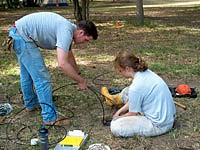
Greg H. and Anne Amanda installing pressure transducers in the slug test well (photo courtesy of Dr. Carolyn Ruppel)
On October 4-7, 2001, Dr. Carolyn Ruppel led students in her environmental field methods class at Georgia Tech to Sapelo Island for hands-on training in environmental field methods. This year the class installed 2 new marsh monitoring wells and 3 multilevel samplers during the trip. (For more information about well techniques, visit the methods section on the Georgia Tech GCE LTER page). The new marsh monitoring wells extend the transect begun by the Fall 2000 EAS 4420 class. Thanks to the Fall 2001 students, the GCE focus site now has 2 marsh-based wells in the Spartina and Juncus marsh on the south side of the hammock.
Students also obtained hands-on experience with numerous techniques including soil core analysis, ground-water hydrology (water level monitoring, aquifer testing, geochemistry, temperature monitoring), environmental geophysics (ground-penetrating radar, DC resistivity, electromagnetic induction), and site surveying. For more information about the 2001 field trip, please see Dr. Ruppel's web page at: http://hydrate.eas.gatech.edu/sapelo/eas4420_01/.
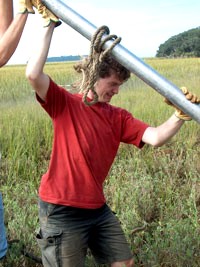
EAS 4420 is a required, research-based course for seniors in the School of Earth and Atmospheric Sciences and has been designed by Prof. C. Ruppel beginning in 1996. Partial support for course formulation in the late 1990s came from NSF's Division of Undergraduate Education. The course is now an annual component of the education and outreach program for the NSF-supported Long Term Ecological Research program for Georgia Coastal Ecosystems. This year, graduate students enrolled in EAS8804CDR to fulfill part of the requirements for the Georgia Tech Hydrogeology Certificate.
For further information about this course, please contact Dr. C. Ruppel, Associate Professor, School of Earth & Atmospheric Sciences, Georgia Tech, Atlanta, GA 30332-0340.
July, 2001 - GCE Schoolyard LTER Pilot (text by Patricia Hembree)
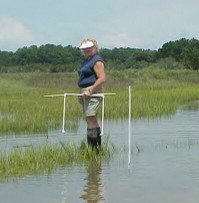
(photo by Theresa Pinilla)
In July, ten educators, 2 facilitators and several LTER scientists worked together to pilot a model for the GCE-LTER Schoolyard Program. Dubbing themselves S.A.P.E.L.O. - Scientists and Professional Educators Learning Outdoors - the team represented educators from both classroom and outdoor programs teaching students from three to eighty-three across Georgia. The model, proposed by the facilitators from the Department of Science Education of the University of Georgia and the Georgia Association of Marine Education (GAME), teamed educators and scientists for a week of research in the salt marshes and waters in and around Sapelo Island and the adjacent mainland... (read full article)
June, 2001 - REU Student Patrick Fulton Participates in GCE Groundwater Study on Sapelo
Patrick Fulton, who is sponsored by an NSF Research Experience for Undergraduate grant and by a School of Earth and Atmospheric Sciences Rutt Bridges Fellowship, is participating with senior Ph.D. student Gregory Schultz and Professor Carolyn Ruppel in a groundwater study at the GCE North Sapelo study site (GCE3). The study will examine submarsh groundwater flow at the estuary boundary using hydrological and geophysical methods. Details of this study and a description of the initial well installation are available on Dr. Carolyn Ruppel's web site at Georgia Tech.
Student Achievements
Sarah Wilhoit recently won the state of Arkansas competition for the
International Science Fair and has advanced to the national
competition in San Jose, California in May 2001. Sarah is a high
school student who was mentored by Dr.
Carolyn Ruppel under the NASA SHARP program during the summer of
2000. She worked in Dr. Ruppel's research group on soil grain size
analyses (as a means of determining hydraulic parameters) along transects
from the marsh to upland at the Kenan Field LTER focus site on western
Sapelo Island. Her work was supervised by 3 PhD students, including LTER
graduate student Greg Schultz. Her teacher, Ms. Alecia Castleberry, has
supervised the completion of the paper based on her research.
Gretchen Goodbody recently won the competition for best undergraduate poster at the Southeastern Estuarine Research Society Meeting in Charleston, SC. The title of her poster was 'Distribution of snails in the Satilla and Altamaha River Estuaries'. Gretchen is a UGA undergraduate student working with Drs. Merryl Alber and T. Dale Bishop studying invertebrate ecology on the Georgia coast.
October, 2000 - Georgia Tech Environmental Field Methods class works on Sapelo Island.
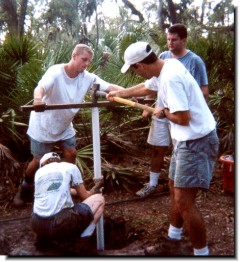
EAS 4420 participants pound in a monitoring well after installation (photo courtesy of Dr. Carolyn Ruppel)
On October 6-8, 2000, Dr. Carolyn Ruppel led students in her EAS 4420 class at Georgia Tech to Sapelo Island for hands-on training in environmental field methods. This year, the class installed 2 PVC monitoring wells which will be used to characterize flow and transport near the marsh that rings the southeastern side of Moses Hammock. (View EAS 4420 research report)
At each monitoring well students make pH and dissolved oxygen measurements, log the conductivity of the waters in the borehole as a function of depth, and take samples for later cation and anion analyses using the EAS atomic absorption and spectrophotometer. Additional groundwater samples were collected for microbiological studies. This year, the students also conducted a directed study to determine whether the geochemistry of well waters changes over the course of a tidal cycle.
Students also conducted static water level measurements in existing wells for comparison with prior results, collected soil samples for grain size analyses, studied survey techniques, and conducted geophysical surveys using electromagnetic induction, DC resistivity, and ground-penetrating radar techniques.
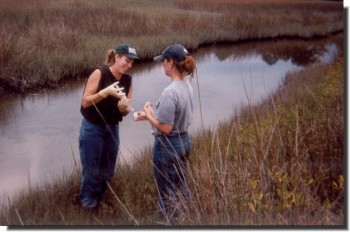
EAS 4420 participants sampling water from a tidal creek on Sapelo (photo courtesy of Dr. Carolyn Ruppel)
This year, students will produce a rough water balance for the island by estimating unknown components of the water cycle and using data from automatic monitoring stations for other components. In addition, Bryan Henry, an EAS senior and Weather Channel employee, is looking at long term climate in this part of coastal Georgia by culling through existing databases and doing a preliminary dendrochronologic study.
For further information about this course, please contact Dr. C. Ruppel, Associate Professor, School of Earth & Atmospheric Sciences, Georgia Tech, Atlanta, GA 30332-0340.

