
Double Your Pleasure, Double Your
Fun.er.Funding!
Teachers and LTER Scientists Reap the Rewards of Additional Funding
By: Patricia A. Hembree, S.A.P.E.L.O. Program Coordinator
Department of Science Education, UGA
The GCE-LTER Schoolyard Project, S.A.P.E.L.O. - Scientists and Professional Educators Learning Outdoors - was able to double its summer program for teachers this year. Thanks to a grant of nearly $25,000 from the Georgia Eisenhower Higher Education Program that was added to the NSF LTER education grant, Sapelo served as an outdoor classroom for 17 teachers during two separate weeks this summer. Following a format similar to last year's successful model, the teachers joined research teams in the daily research activities that make Sapelo so beguiling. As the teachers became students of field science for a week, they were able to live the daily (and sometimes nightly!) experiences of a community of learners very different from that of the science classroom - on any level. Current research in education bemoans the lack of real-world examples of science - especially local science - in classrooms from kindergarten to college. Likewise, the LTER network emphasizes dissemination and collaboration with formal and informal education. This program brings the two together with a powerful third element - exposure to a type of science "knowing and learning" that isn't found in most science teacher education programs. For many participants, it was a brand new world of science, one they can easily see fitting into their curriculum as excellent examples of inquiry based science they think many students will enjoy. For others, this was their second summer of being involved with the S.A.P.E.L.O. program where they continued to establish links to the parallel projects they started last year in their classrooms. Often acting as mentors, the original group strongly believes in the LTER goals of the long temporal and broad spatial aspects of science. As a representative group of teachers from all corners of Georgia, they see their continued involvement as not only holding true to those goals, but as empowering within their own school districts. Seen as part of a unique cadre of real scientists, many of these teachers are enjoying a new - and louder - policy voice in their schools.
And the benefits keep coming. The new Eisenhower funding will provide partial support for the teachers to present their parallel classroom projects at the annual conference of GSTA (Georgia Science Teachers Association) in February, 2003. Thanks to many evening hours spent this summer in small group reflection, every teacher went away from their experience with a multitude of implementation ideas, aided by stories of last year's successes and failures. The impact that S.A.P.E.L.O. is having on this cadre of science teachers is to be presented at an international conference of qualitative researchers and a national meeting of science teacher educators. Additionally, every teacher will have the opportunity to return to Sapelo for a long weekend in November. That time will be spent in solving design problems for the parallel classroom projects, renewal of purpose, and additional reflection on the program.
With an eye toward 2003, we share some of the comments and photos from this
summer. If you have any questions, comments or stories to contribute, please
feel free to contact me via email: phembree@uga.edu.
 |
My week at Sapelo gave me the confidence to give my students pure science, to let them experience what it's all about. Sapelo took some of the mystery out of my image of the scientific community. I see scientists now as real people doing real things. Elementary School Teacher. (Photo by: Ken Leach) |
|
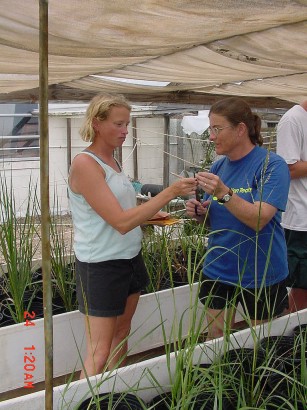
This has gotten me "FIRED UP" to teach this year! It has opened my eyes to new possibilities for myself and my students. I have something cool for kids to do and observe that will stimulate interest in Georgia's coast - which many students haven't even seen. Middle School Teacher. (Photo by: Patricia Hembree) |
 |
 |
This gave me the opportunity to become a better teacher and scientist in my own way. I am trying to incorporate (the research from) Sapelo any time I create an arbitrary data table. The students eat it up! High School Teacher. (Photo by: Ken Leach) |
|
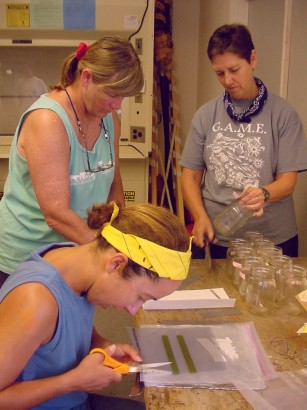
This project has been invaluable to me as a way to learn how scientists really work. It has provided a wonderful key for unlocking the doors to integrating science in my classroom and my district. I get introduced by my administrators as someone who has been working on Sapelo! (Photo by: Patricia Hembree) |
 |

