UGA Marine Biology Class Fouling Community Study

Drs. Mary Ann Moran, Merryl Alber, and Dale Bishop are leading students in a long-term program to monitor attached invertebrate communities on Sapelo Island. Undergraduates enrolled in the UGA Marine Biology class (MARS 3450) inventory the fouling organisms in the Duplin River as part of an annual spring field trip to the UGA Marine Institute.

The class deploys samplers at three stations along the River (at Marsh Landing, Post Office Creek, and Hunt Camp (GCE 10)) and makes observations of the epifauna associated with each site. Samplers were first deployed in March 2002, and the first retrieval occurred in March 2003.

Samplers

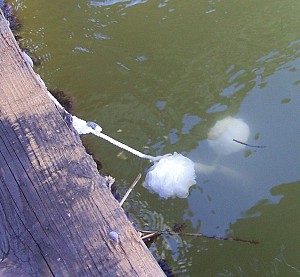
Samplers consist of 2 PVC pipes (25 cm in length) and 2 "poofy sponges" attached to a line and then tied to a dock. The sampler arrangement allows us to compare the invertebrates collected at different depths and on different substrates.

Fouling sampler
(photo courtesy of Mary Ann Moran)

Fouling sampler (1 year)
(photo courtesy of Merryl Alber)

Sample retrieval

After a year in the field the samplers are heavily colonized by invertebrates. The class focuses on barnacles (Balanus eburneus) and tunicates (Molgula manhattensis), which are two of the main colonizers, but also makes a list of all of the species observed.


2003 Field Notes and Preliminary Data

Samplers retrieved: 08-Mar-2003

Personnel: Merryl Alber, Mike Daniel, Jen Fisher Theresa Garrand, Kelly Hood, Shari Lacheen, Tirzah Lyons, Stephen O'Connell, Tom Shannon, Erin Vinson

Field notes: This year's class only looked at the samplers from Marsh Landing and Post Office Creek, because the roads were closed and Hunt Camp was inaccessible. At Marsh Landing, the bottom puffy sponge was missing from the rig. The top 5-6 inches of the top PVC pipe was clean and uncolonized. There were lots of large barnacles at Marsh Landing, whereas Post Office Creek had lots of tunicates and bryozoans and fewer barnacles. We sawed opened the pipe from Post Office Creek and found tube worms and barnacles on the inside.

Barnacle:Tunicate Ratio

Location Top pipe Bottom pipe
Marsh Landing 6:2 6:0
Post Office Creek 0:20 10:5

Barnacle Size

Location Basal diameter Top diameter
Marsh Landing 19.8 ± 3.7 mm 13.3 ± 2.2 mm
Post Office Creek 11.6 ± 2.2 mm 7.5 ± 1.4 mm
LTER
NSF

This material is based upon work supported by the National Science Foundation under grants OCE-9982133, OCE-0620959, OCE-1237140, OCE-1832178 and OCE-2425396. Any opinions, findings, conclusions, or recommendations expressed in the material are those of the author(s) and do not necessarily reflect the views of the National Science Foundation.